The internet gave every colour of noise a job. The evidence did not
What brown, pink, and white noise may do for focus and what the colours actually mean.

The useful part
Key takeaways
- Choose sound by task, masking needs, and preference rather than colour myths.
- White and pink have limited task-performance evidence; brown-noise claims run ahead of the research.
- Keep volume low enough for the background to remain background.
What brown, pink, and white noise may do for focus and what the colours actually mean.
The internet has assigned a job to every colour of noise. White is for concentration. Pink is for sleep. Brown is for ADHD. Green is for calm. Blue is for energy. Somewhere, someone is probably uploading violet noise for people who need to finish a spreadsheet before lunch. The certainty arrived before the evidence did. White, pink, and brown noise are real acoustic categories. They distribute sound energy differently across frequencies. That changes what they sound like.
It does not give each one a psychological profession.
A frequency profile is not a treatment plan.
Brown noise may feel deeper. Pink may feel softer. White may cover a nearby conversation more effectively. Those are useful differences. “Brown noise puts the ADHD brain into deep focus” is a different kind of sentence. It sounds like the first three sentences. It is not supported like them. The responsible answer is less dramatic:
Some steady sounds may help some people during some tasks. They may do it by masking irregular noise, by marking the beginning of a work block, or, under limited experimental conditions, by affecting task performance. The colour alone does not tell you which of those things will happen. That makes the answer less marketable. It also makes it more useful.
The colours describe the sound, not the listener
The names are borrowed from light. White light contains a broad range of visible wavelengths. White noise contains equal power per unit of frequency across its range. Pink noise reduces power as frequency rises. Compared with white noise, it places relatively more energy in the lower frequencies. Brown noise, also called Brownian or red noise, reduces the higher frequencies more steeply again. The result is easy to hear:
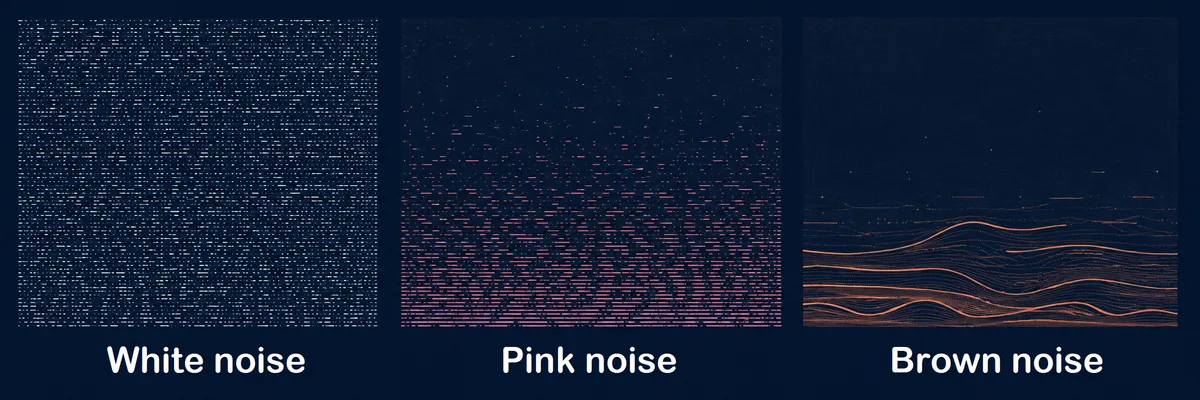
| Sound | Simplified acoustic profile | What it often resembles |
|---|---|---|
| White noise | Equal power per unit of frequency | Radio static, hiss, air escaping |
| Pink noise | Progressively less power at higher frequencies | Steady rain, distant surf, softer rushing |
| Brown noise | A steeper reduction in higher-frequency power | Deep rumble, heavy wind, low waterfall |
These descriptions concern the spectrum of the sound. They do not predict whether you will become focused, calm, sleepy, irritated, or desperate to turn it off, as explained in an Australian Acoustical Society review of coloured-noise research.1 Two tracks carrying the same label may also sound different. One brown-noise recording may have a soft, even rumble. Another may contain obvious loops, heavy bass, or a faint mechanical pulse. Your headphones, speakers, room, volume, and the way the file was produced all change the experience.
The label tells you something. It does not tell you everything you are hearing.
White, pink, and brown are families of sound. They are not prescriptions.
The internet made one leap too many
The first step is acoustic: Brown noise has more low-frequency emphasis than white noise. The second step is personal: I find lower sound easier to ignore. Both can be true. Then comes the leap: Brown noise improves focus because low frequencies regulate the brain. That sentence needs evidence the first two did not provide. People make the leap because the experience feels convincing.
You put on a deep, steady sound. The conversation in the next room becomes less distinct. The small changes in the environment become harder to notice. Ten minutes later, you are still working. The sound may have helped. But several things happened at once. You covered the room. You began a deliberate work block. You reduced the number of noticeable changes around you. You may also have expected the sound to help. Then you completed some work. We compress all of that into:
Brown noise made me focus.
That may be a reasonable personal summary. It is not yet an explanation.
Masking is not the same as improving attention
A steady sound can make an irregular environment feel steadier. Speech appears and disappears. Doors close. Traffic rises and falls. Someone moves a chair. A notification arrives from a device you had forgotten was in the room. A continuous background reduces the contrast between those events and the quieter moments around them. That is masking. Masking can be valuable. It is also different from changing the underlying ability to sustain attention. Separate three possible effects:
- Masking: the sound makes environmental changes less noticeable.
- Boundary: pressing play marks the start of a work period.
- Cognitive effect: the sound itself changes performance on an attention task.
The first can happen without the third. The second can matter even when the sound has no special neurological property.
A sound does not have to improve your brain to improve your room.
That distinction changes the question you ask. Instead of:
Did this sound put me into deep focus?
Try:
Did I notice the room less?
Or:
Did this become background quickly enough for the work to remain in front?
Those observations are smaller. They are also easier to trust.
What the strongest recent attention study found
A 2024 systematic review and meta-analysis examined white and pink noise during laboratory tasks in children and college-age young adults with ADHD or elevated ADHD symptoms.2 It included 13 studies, 335 participants, and 41 effect sizes. Across those studies, white or pink noise produced a small average improvement in task performance for the ADHD or elevated-symptom groups. In non-ADHD comparison groups, the average effect was small and negative. That is worth knowing. It is not the same as proving that noise improves everyday focus.
The studies differed in their participants, tasks, noise levels, and methods. Laboratory attention tests are not the same thing as drafting a proposal for an hour, studying in a shared kitchen, or trying to resume work after a difficult meeting. The result also concerned white and pink noise together. It did not establish that pink was better than white. It did not establish a benefit from brown noise. It did not show that noise should replace ADHD assessment, treatment, accommodations, or professional support.
And it did not show that everyone with ADHD will respond in the same way. An average effect is a description of a group. You are not an average with headphones on.
The brown-noise claim has outrun the research
Brown noise is often the most confidently marketed colour. It is deep. It sounds substantial. People describe it as wrapping around thought, quieting internal noise, or producing an immediate sense of mental weight. That language is vivid. The research is not.
A 2024 Australian Acoustical Society conference paper reviewed three recent systematic reviews covering noise, cognition, and sleep. Most of the underlying research concerned white or broadband noise. Only five studies in the cognition review involved pink noise, and none of the included studies tested brown or other coloured noises. The paper concluded that current evidence does not support assigning different cognitive or sleep benefits to different colours.1 That does not prove brown noise is useless.
It means the evidence needed to declare it uniquely useful is missing. There is an important difference.
No evidence of a special benefit is not evidence that nobody enjoys it.
You may prefer brown noise because white noise feels sharp. You may find its lower spectrum more comfortable on your equipment. It may cover the particular sounds in your environment well enough for you to stop noticing them. All of that can make brown noise the right choice for you. It still does not make “best for ADHD” a responsible product claim.
So which one should you choose?
Choose by the problem in front of you. Not by the personality the internet assigned to the colour.
Try white noise when the room is the problem
White noise contains strong high-frequency energy. That can make it effective at covering speech, clicks, and sharper environmental sounds. It may suit you when:
- nearby conversation keeps breaking through;
- sudden, higher-pitched sounds are the main distraction;
- you want a plain signal without rhythm or musical movement.
It may not suit you when:
- the hiss feels harsh;
- reading becomes more tiring;
- you keep raising the volume to make it tolerable or effective.
White noise is not the “strong” option. It is one acoustic shape.
Try pink noise when white feels too sharp
Pink noise has less high-frequency emphasis. Many listeners experience it as fuller or softer than white noise. It may suit you when:
- white noise covers the room but feels abrasive;
- you want a broad sound with less hiss;
- the environment changes, but not enough to require aggressive masking.
Pink noise is not automatically more natural. Rain and waves are complex environmental recordings, not necessarily pure pink-noise signals. A track can resemble rain without being acoustically identical to it. The useful point is simpler: Pink may be easier to leave in the background.
Try brown noise when you prefer depth
Brown noise places still more emphasis on the lower frequencies. It may suit you when:
- higher-frequency sound feels distracting;
- you prefer a deep, enveloping background;
- your headphones or speakers reproduce bass cleanly at a modest level.
It may not suit you when:
- the low rumble feels physically tiring;
- it masks less of the speech or sharper sound around you;
- the bass becomes the most noticeable object in the room.
Choose it because you prefer the sound or because it fits the environment. Not because the colour promises a diagnosis-specific result.
Choose silence when silence wins
Silence has poor marketing. It cannot be named after a colour, placed in a twelve-hour video, or sold as a scientifically tuned frequency environment. It remains a complete option. Use silence when:
- the environment is already quiet;
- the task requires close listening;
- every background becomes something you monitor;
- the sound creates fatigue or irritation;
- effective masking would require an uncomfortable volume.
No background is not a failed sound test.
Sometimes the sound asking least from your attention is no sound at all.
The task matters more than the colour
A sound that works for one task can interfere with another. This is not inconsistency. The task changed.
Reading and writing
Language-heavy work already places demands on verbal processing. Begin with silence or a steady, low-change texture. Avoid speech, lyrics, and obvious sonic events when they compete with the words in front of you. White noise may mask a conversation well but feel tiring. Pink or brown noise may feel softer but fail to cover the speech. The right answer depends on which problem is larger.
Repetitive administration
Filing, sorting, formatting, or processing familiar items may tolerate a more active background. That does not mean the sound improves accuracy. It means the task may leave more room for movement in the background.
A shared office or household
Here, masking may matter more than colour. The best sound may be whichever one reduces the contrast between quiet moments and sudden speech without becoming louder than it needs to be. A track that sounds beautiful in a silent preview may fail in the actual room. Test it in the room.
Creative exploration
Some people prefer more harmony, texture, or movement while generating ideas. Interesting sound can make work feel easier to enter. It can also become the foreground. There is no contradiction. Interest is useful until it begins asking for the attention the task needs.
Unwinding
Do not carry focus-performance language into every part of wellness. When the aim is to unwind, comfort and preference may matter more than productivity. You do not need to prove that a sound improved a laboratory score before finding it pleasant. You only need to avoid turning that preference into a universal promise.
Run a test that is smaller than the claim
Do not compare three noise colours by listening to each for ten seconds. Ten seconds tells you which introduction you prefer. It does not tell you which sound becomes background during work. Use two short sessions.
Session one
Choose a specific task. Not “work.” Something like:
- read six pages of a technical document;
- edit one section of a proposal;
- process ten routine emails;
- reconcile one section of a spreadsheet.
Select one background: white, pink, brown, or silence. Use it for 15 minutes at a modest volume. At the end, answer:
Did the sound become background?
Then record one result:
- easier to ignore;
- no meaningful difference;
- more distracting;
- masked the room but made the task harder;
- not enough information.
Session two
Repeat with a similar task at a similar time of day. Change only the background when possible. Then ask:
Would I choose this sound again for this task?
That question is more useful than:
Did it optimise my brain?
You are not conducting a clinical trial. You are checking whether a particular environment helps you do a particular thing.
The best personal test does not prove the sound works. It helps you choose what to play tomorrow.
Volume matters more than the colour
A soft brown track is not dangerous because it is brown. A loud white track is not safe because it is marketed for focus.
Hearing risk depends on sound level, listening duration, and repeated exposure. World Health Organization safe-listening guidance gives an example of up to 40 hours per week at an average of 80 dB. At 90 dB, that example falls to four hours per week. WHO also recommends keeping device volume below roughly 60% of maximum, using monitoring features where available, and taking quiet breaks.3 The exact exposure reaching your ear depends on the device, headphones, fit, recording, and environment. So use the practical rule:
The background should remain background.
Start at the lowest useful level. Do not raise the volume repeatedly to defeat a loud room. Noise-cancelling or well-fitting headphones may reduce the need to do that. Take breaks during long sessions. Stop when you notice discomfort, ringing, buzzing, or temporary muffling. Persistent symptoms deserve professional advice.3 A longer session is not a better session. A louder sound is not working harder for you.
A soundscape is not the same thing as coloured noise
Pure coloured noise is defined by its spectral profile. A soundscape may combine environmental recordings, texture, harmony, rhythm, or gradual movement. That often makes soundscapes more pleasant. It can also make them more noticeable. A pure pink-noise track may become background quickly but feel sterile. A rain soundscape may feel warmer but contain changes that pull you away from reading. An ambient composition may make routine work easier to enter but compete with complex writing. There is no single hierarchy. Choose according to the task:
| Task or environment | Useful starting point |
|---|---|
| Dense reading or writing | Silence or a steady, low-change texture |
| Repetitive routine work | A slightly more active, familiar background |
| Shared or changing environment | A texture with useful masking properties |
| Creative exploration | More movement, provided it stays behind the work |
| Unwinding | Comfort and preference over performance language |
The useful description is not:
Scientifically designed for deep focus.
It is:
Steady, low-change texture designed to remain in the background during reading or focused work.
The first promises an outcome. The second helps the listener choose.
Where Vayvio fits
Vayvio does not need to declare a winning colour. It needs to help you hear the difference. Choose a steady texture when the room feels active. Choose something deeper when high frequencies feel tiring. Choose a little more movement when the task is repetitive. Choose silence when sound becomes one more thing to manage. Then notice what happened. Did the track become background? Did it cover the room but interfere with the task? Would you use it again for this kind of work?
Those are modest questions. They are also how a useful sound library becomes personal without pretending to be clinical. You can run the test with any audio player and a timer. You do not need Vayvio to discover that white noise feels harsh or that silence works better for reading. But when you want carefully described soundscapes, a protected work block, and a simple way to keep what worked for the next session, that is the space Vayvio is designed to hold.
Explore Vayvio soundscapes or join the beta list.
Choose the sound that disappears
White noise is not focus. Pink noise is not sleep. Brown noise is not ADHD. They are sounds with different spectra. That is less magical than the internet promised. It is enough. One may cover the conversation beside you. One may feel softer. One may sit comfortably beneath the task. One may become irritating before the first paragraph is finished. Try them quietly. Try them during real work. Keep the one that leaves the task in front.
The best focus sound is not the one with the strongest claim. It is the one you no longer have to listen to.
Sources and further reading
- Wilson, W. J. (2024). Conference review of three systematic reviews, not a new meta-analysis.The Effect of White Noise and ‘Coloured’ Noise on Cognition and Sleep.Proceedings of Acoustics 2024, Australian Acoustical Society
- Nigg, J. T., Bruton, A., Kozlowski, M. B., Johnstone, J. M., and Karalunas, S. L. (2024). 63(8), 778–788.Systematic Review and Meta-Analysis: Do White Noise or Pink Noise Help With Task Performance in Youth With Attention-Deficit/Hyperactivity Disorder or With Elevated Attention Problems?Journal of the American Academy of Child & Adolescent PsychiatryFull text