You do not have to clear your mind before you begin
How to start working when your mind feels noisy.

The useful part
Key takeaways
- Park no more than three competing thoughts.
- Name one visible action and choose a short work block.
- Leave one useful return point when the block ends.
How to start working when your mind feels noisy.
People talk about focus as though it begins when the noise stops. It does not. You sit down to work and remember the message you have not answered. The invoice you need to check. The train you need to book. The sentence from yesterday that still sounds wrong. None of these thoughts is doing anything useful. All of them have arrived for the meeting. So you decide to clear your mind before you begin. Now you have two tasks.
The work, and becoming the kind of person who feels ready to do it. The second task usually wins.
You do not need a quiet mind to begin. You need one action that is clearer than the noise around it.
That is a smaller promise. It is also one you can keep. The routine is simple:
Park → Name → Bound → Begin → Keep
It takes about two minutes to set up. Then you give the work ten, fifteen, or twenty-five minutes. The aim is not to stop thinking. It is to stop every thought from having an equal vote.
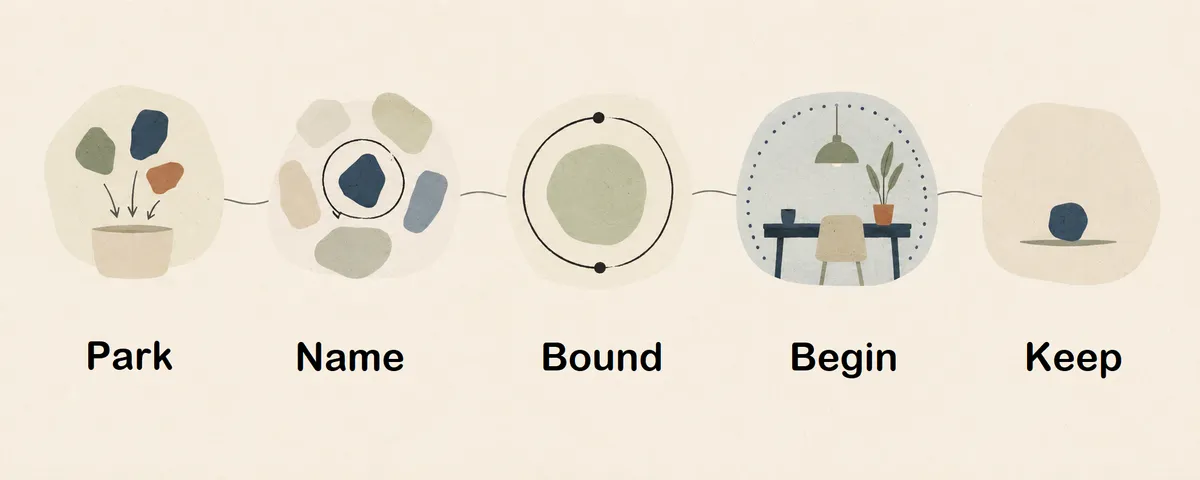
1. Park what is shouting
Open a scrap note. Write down the three things pulling hardest at your attention. Not everything you need to do. Not a complete inventory of your life. Three lines. For example:
- Reply to Sam about the deck.
- Check whether the invoice was sent.
- Book the train after this session.
That is enough. The note is not a new productivity system. It is somewhere for the thoughts to wait. Research on interruptions and task switching suggests that competing cues can interfere with ongoing work, although the effect varies by task and person. You do not need to understand the entire science of attention to notice the practical problem: it is difficult to write one sentence while mentally rehearsing four unrelated ones.
A loose end does not always need to be closed. Sometimes it only needs an address.
Stop after three lines. This matters because a brain dump can become avoidance wearing office clothes. You begin by writing down everything on your mind. Forty minutes later, the list is colour-coded and the work is untouched. When the loudest thought is emotional, write down its practical edge.
Action later: Ask whether the deadline has changed. Not for this block: Decide what the change means for the whole project.
You are not pretending the concern has disappeared. You are deciding that it does not get to run this particular ten minutes.
2. Name something you could watch yourself do
“Work on the presentation” is not an action. It is a region. You can stare at a region for a long time without entering it. Name the next movement instead:
- Open slide 7 and replace the placeholder bullets.
- Read the first saved abstract and write one sentence about it.
- Reply to the two emails blocking someone else.
- Open the document and reread the final paragraph.
- Write three rough bullets under “Risks.”
The action does not have to be the most important thing you will do today. It has to be a believable way into the work. Use this sentence:
For the next block, I will [visible action].
A useful action usually has three parts. It begins with a verb. It points to an object or location. You can tell when it has started. “Think about the proposal” fails all three. “Write three bullets under ‘Client impact’” does not. We often wait for motivation because the task is still too large to touch. Then we call the waiting procrastination, which makes us feel worse, which makes the task harder to touch. The problem was not always motivation.
Sometimes the door was simply too large to recognise as a door.
3. Put a wall around the beginning
Choose a duration before you start. Ten minutes when the friction is high. Fifteen when you have some momentum. Twenty-five when the work is clear and your energy is decent. Not an hour. Not until the task is finished. Not until you become a different person. Ten, fifteen, or twenty-five minutes.
A timer is not a promise that you will feel focused. It is a promise that you will reconsider later.
That is why it helps. A large task appears to ask for the whole afternoon. A ten-minute block asks for the next ten minutes. The work has not become smaller. Your commitment has. You can continue when the timer ends. You can also stop. The boundary is there to make starting easier, not to trap you once you have begun. Your attention may still move. You may read the same sentence twice. You may reach for another tab and catch yourself halfway there.
That does not mean the block has failed. Focus is not the absence of leaving. A lot of the time, it is the act of returning.
4. Choose a background that does not need you
Silence is useful because it asks for nothing. Some sounds can do the same. A steady ambient texture. A familiar instrumental loop. Rain that does not suddenly become thunder. A soft background you stop noticing once the work begins. For reading, writing, and other language-heavy tasks, lyrics or changing speech may compete with the same processes the task needs. Repetitive work may tolerate more movement. Preference, familiarity, volume, environment, and the task itself all matter. These are starting points, not laws.
The best focus sound is not the one you admire. It is the one that leaves you alone.
Keep the volume low. World Health Organization safe-listening guidance explains that hearing risk depends on both listening level and duration, and safe exposure time becomes shorter as volume rises.1 Then begin the visible action immediately. Do not spend fifteen minutes searching for the perfect soundscape. Do not wait for the music to create a feeling. Do not ask the background to make you focused. Ask it not to interrupt. If silence works, use silence. If the sound becomes another thing to manage, turn it off.
5. Leave one thing behind for your return
When the timer ends, ask:
What would make returning easier?
Write one line.
- Continue from the second paragraph.
- The missing number is in the April spreadsheet.
- Ask Jo whether the scope includes mobile.
- Add one example beneath bullet two.
- This sound was too active for reading.
- Nothing to keep today.
This is not a performance review. “I should have concentrated better” tells your future self nothing. It is criticism without directions. A useful return line usually records one of four things: the next action, an unresolved question, the location of important information, or a condition that helped or distracted. One line is enough. People imagine productive work as a clean sequence. You start, enter a focused state, and stay there until the task is complete. Most real work is messier.
You begin. You stop. Someone interrupts you. You lose the thread. You return tomorrow and spend twelve minutes remembering where you were.
A return point is a note from the person who still remembers to the person who soon will not.
Leave the note.
What the routine looks like in practice
You need to prepare a client proposal. Three messages are waiting. A scheduling problem is unresolved. A spreadsheet total may be wrong. The proposal is open, but every section appears to be asking for the entire proposal at once. So you make the start smaller.
Park
- Reply to the scheduling message after this block.
- Check the spreadsheet total later.
- Ask about the budget ceiling.
Name
Open the proposal and write three bullets under “What changes for the client.”
Bound
Fifteen minutes.
Begin
Silence notifications. Choose a steady, lyric-free background at low volume. Start the first bullet before deciding whether you feel ready.
Keep
“Next: add a concrete example beneath bullet two.” You may finish three useful bullets. You may write one bad sentence. The routine has still done its job if the work became easier to enter and easier to return to.
“I cannot focus” can mean six different things
We often use one sentence for several different problems. “I cannot focus” might mean the task is too large. It might mean the environment is loud. It might mean you have just been interrupted. It might mean you do not know what the task requires. It might mean you are exhausted. Those problems do not need the same answer.
| What is happening? | First move | Starting boundary |
|---|---|---|
| Too many loose ends | Park up to three thoughts | 10 minutes |
| The task feels too large | Name one visible action | 10–15 minutes |
| The environment is distracting | Choose silence, masking sound, or another space | 15 minutes |
| You were interrupted | Write down the return point | 5-minute reset, then 10–25 minutes |
| The task is unclear | Identify the missing decision or ask for clarification | No timer needed |
| You are tired or unwell | Reduce the task, postpone it, or stop | Do not use a timer to override a basic need |
A smaller start helps when the problem is starting. It cannot clarify a contradictory brief. It cannot make an unrealistic workload reasonable. It cannot replace sleep. It cannot turn an urgent personal problem into background noise.
Not every difficult beginning is a discipline problem.
Sometimes the honest answer is to ask a question, change the environment, reduce the work, or stop. Repeated concentration difficulties can also deserve professional assessment or support. A wellness routine is not a diagnosis or treatment.
Where Vayvio fits
Vayvio is being built for the space between intending to begin and actually beginning. You choose a soundscape. Set a short timer when a boundary would help. Stay with one piece of work. Then, when the session ends, keep a thought for the next return. The reflection is optional. The journal is optional. Feeling transformed is not required. The point is not to manufacture a perfect state before work can happen.
It is to give the first action somewhere to begin, and the next session somewhere to return. You can use this routine now with a scrap of paper and any timer you already have. You do not need Vayvio to start. But when you want the sound, timer, check-in, and return point to live in one private flow, that is what Vayvio is designed to hold. Explore Vayvio soundscapes or join the beta list.
Begin before the room becomes quiet
Choose one visible action. Give it ten minutes. When the timer ends, leave one line for the person who will return. Your mind may still be noisy. The loose ends may still exist. You may not feel calm, disciplined, or particularly ready. That was never the requirement.
The work did not need your whole mind. It needed a place to start.
Sources and further reading
- Deafness and Hearing Loss: Safe Listening.World Health Organization