

The useful part
Key takeaways
- Use one line to remember, decide, return, or set something down.
- Choose prompts that leave room for neutral or uncertain answers.
- Skip writing when the page adds pressure or is not the right place.
One useful line can be enough.
Journaling has become a type of person. She wakes early. She owns the right notebook. She writes three pages before breakfast and has somehow already identified what the day is trying to teach her. You are not that person. So the notebook stays empty. This is treated as a failure of discipline. It may be a failure of the offer. You wanted somewhere to put one thought. The journal asked for a relationship.
A daily practice. A streak. A full page. Better handwriting. Greater honesty. A lesson at the end. Perhaps gratitude in the final paragraph.
Most people are not afraid of the blank page. They are afraid of the contract hidden inside it.
The contract says that opening the journal means becoming someone who journals. It does not. A journal can do one job and close. It can leave a return point. Name the next action. Record what changed. Put a boundary around something that does not need to be solved tonight. One line can be enough. Not because one line is scientifically proven to transform your mental health. It is not.
Research on journaling usually studies something much larger than the note described in this article. A 2022 systematic review and meta-analysis examined structured journaling interventions as an addition to care for people experiencing mental health concerns. It reported a small average improvement, while presenting journaling as an adjunct rather than a replacement for established treatment.1
A 2025 systematic review examined positive expressive-writing exercises in non-clinical adults. It found more consistent benefits for wellbeing and positive affect than for stress, anxiety, physical health, or other negative outcomes. The studies were varied, and all were rated poor or fair in quality. Importantly, the review required expressive writing in detail and excluded lists, note-taking, and brief jottings.2 Neither study proves that a one-line note improves health. That is not the claim here. The claim is smaller:
A line can help you remember, decide, return, or stop carrying something for now.
Sometimes that is the whole job.
The journal does not need the whole story
You finish a work session halfway through a paragraph. Tomorrow, the document will still be there. The context may not be. So you write:
Next time, begin with the missing example under “Risks.”
That is a journal entry. You finish a five-minute reset and know what needs to happen next:
Now I will make food before opening another work tab.
That is also a journal entry. A soundscape ends. You do not feel calmer. You notice one thing:
The sound was too active for reading.
Still an entry. A difficult decision keeps reopening while you are trying to sleep:
I am not deciding this tonight. Tomorrow I will list the two options and the information I am missing.
The line did not resolve the decision. It gave the decision office hours.
A thought does not always need to be explored. Sometimes it needs somewhere to wait.
There are four useful ways to do that. Choose one. Do not answer all four.
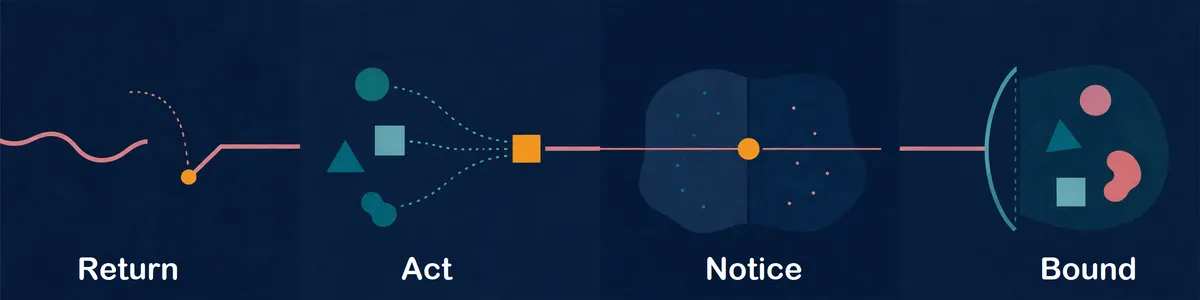
1. Leave a return point
Use this when you are stopping before the work is complete. The usual note is:
I need to finish this.
That records pressure. It does not record context. Tomorrow, you will still know that the report needs finishing. What you may not know is where to begin, which claim was unresolved, or why row 14 mattered. Write:
Next time, start with…
For example:
- Next time, check the pricing assumption in row 14.
- Next time, open the transcript at 18:20.
- Next time, ask whether the mobile flow is in scope.
- Next time, continue from the second paragraph under “Risks.”
- Next time, compare the two headings before rewriting either one.
A return point is not a summary of the session. It is a set of directions left by the person who still remembers.
Your future self does not need encouragement. Your future self needs the address.
Stop when the restart is clear. Do not explain everything that happened. Do not assess whether the session was productive enough. Do not turn the final minute of work into a review of your character. Leave the address. Close the page.
2. Name the next action
Use this when several possibilities are competing. Write:
Now I will…
For example:
- Now I will reply to Sam with the revised date.
- Now I will read the first two pages and then decide whether to continue.
- Now I will put the ingredients on the counter.
- Now I will ask for the missing figure.
- Now I will leave this until tomorrow morning.
The last one counts. A next action can be a deliberate pause. This is difficult to accept because productivity advice has taught us that every reflection must end in movement. Sometimes the useful movement is closing the laptop. Sometimes the decision is not to send the message while angry. Sometimes the next action belongs to tomorrow. Make the line visible. “Be more productive” is not visible. “Work on the proposal” is not visible. “Open the proposal and write three rough bullets under ‘Risks’” is.
A good next action is small enough that you could watch yourself begin it.
Once it is clear, stop writing. The journal has handed the moment back to your life.
3. Record a neutral observation
A lot of reflection prompts already know the answer they want. What feels lighter? What progress are you proud of? How did the practice help? What are you grateful for? These can be useful questions when you choose them. They become strange when every experience is required to end well. You play a soundscape. It irritates you. You finish a guided session. Nothing noticeable changes. You take five minutes to reset and remain worried about the exact thing that worried you before.
Then the prompt asks how much better you feel. Now you have to manage the experience and protect the prompt from disappointment. Try:
What feels different, if anything?
Possible answers:
- The room is easier to ignore.
- My thoughts are still busy.
- I feel more awake, but the task is still unclear.
- The sound was too active for reading.
- I noticed more tension than I expected.
- Nothing noticeable changed.
- I do not know yet.
All of those complete the prompt.
Reflection becomes dishonest when the conclusion is written before the experience happens.
Neutral does not mean cold. It means the answer remains yours. “No change” may tell you that the sound did not suit the task. That the session was too short. That today was difficult. Or simply that no change occurred. It does not have to become a lesson. Some information is useful before it becomes uplifting.
4. Set a boundary
Use this when a task, question, or concern keeps reopening. Write:
This can wait until…
For example:
- This can wait until the 09:30 planning block.
- This can wait until I receive the missing figure.
- This can wait until Monday; nothing needs to be sent tonight.
- This cannot wait. I need to call now.
The final line matters too. A boundary does not always postpone the problem. Sometimes it reveals that the problem needs action. The point is to replace vague continuation with a decision. When the concern is large or emotional, write the practical edge:
I am not resolving the whole decision tonight. Tomorrow I will list the two options and the information I am missing.
You are not claiming that the worry has disappeared. You are deciding when it will next receive your attention.
A boundary is not pretending something does not matter. It is deciding when it gets to matter again.
That decision may not stop every thought. It gives you something factual to return to when the thought reappears: The next step exists. The time exists. You do not have to invent both again tonight.
The blank page is asking four questions at once
A blank page looks simple. It is not. It asks: What matters? How much should I write? What kind of thing is this supposed to be? When am I allowed to stop? That is a lot of decisions for someone who opened the journal because there were already too many decisions. A prompt removes the first question. A stop rule removes the last.
| Situation | Prompt | Stop when |
|---|---|---|
| You finished a work block | What would make returning easier? | The restart is clear. |
| You are between tasks | What matters next? | You have one visible action. |
| A session ended | What feels different, if anything? | “No change” completes the answer. |
| The day feels crowded | What can wait? | One boundary has been named. |
| You want to preserve something | What is worth keeping? | The useful detail is recorded. |
| Nothing feels useful to write | Do not write. | Close the journal. |
The final row is not a joke. An optional journal needs a visible exit. Otherwise “optional” means you may skip it but will be quietly judged by the empty state, the unfinished prompt, the broken streak, or the interface that asks whether you are sure.
A journal without a way to leave is homework.
Close it when there is nothing useful to keep.
One line is permission, not a new limit
Once people escape the rule that they must write a page, it is easy to create another rule: Only one line. Now the second sentence feels excessive. That is not the point. “One line is enough” means you are allowed to stop after one line. It does not mean you must. Write more when:
- you are comparing two decisions;
- tomorrow’s context will be difficult to reconstruct;
- a pattern needs examples;
- writing is what you deliberately chose to do;
- one line opened something you want to continue exploring;
- the detail itself is useful.
A journal can contain fragments. Questions. Lists. Corrections. Contradictions. An unfinished thought that remains unfinished. It does not have to read like an essay. You are not submitting it. You do not have to make the ending deserve the beginning. Stop when the entry begins repeating itself, becomes a performance, or keeps you from the action you have already identified. Sometimes more writing creates clarity. Sometimes more writing is the delay. The difference is not the word count.
It is whether the next sentence is still doing useful work.
Do not force a better ending
There is a particular kind of pressure hidden inside positive reflection. The day was difficult. The prompt asks what it taught you. The session did not help. The prompt asks what shifted. You are not grateful. The prompt has already provided three empty spaces. Forced positivity is not only emotionally irritating. It can make the record less accurate. Compare:
What progress are you proud of today?
with:
What moved forward, if anything?
Compare:
How did this practice make you feel better?
with:
What feels different, if anything?
Compare:
What lesson did the challenge teach you?
with:
What is worth remembering about what happened?
The second questions leave room for a good answer. They also leave room for a difficult, neutral, or uncertain one.
A useful prompt opens a door. It does not stand behind you and push.
You can still choose gratitude. You can still record something good. You can still write that the session helped. The difference is that the page did not demand it.
Try seven days without building a streak
The easiest way to make journaling unpleasant is to make the first entry responsible for every future entry. Day one becomes a promise. Day two becomes evidence. Day three becomes a streak. Day four becomes a test of whether this is “working.” Try something smaller. During the next seven days, write no more than three entries:
- one return point after work;
- one next action after a transition;
- one neutral observation after a soundscape, reset, or guided session.
You may write fewer. You may write none. At the end of the week, ask:
- Did any line make returning easier?
- Did any line prevent a decision from reopening?
- Which prompt felt natural?
- Which prompt created pressure?
- In which moments would I use this again?
Keep the useful prompt. Delete the rest.
A journal earns a place by being useful, not by being used every day.
One line that saves tomorrow ten minutes can be more valuable than seven pages written to protect a streak.
A private journal is two separate promises
A journal app can feel private because the screen is personal. That does not explain what happens to the text. “Private” may mean other users cannot see it. It may mean employees usually do not access it. It may mean the text is encrypted in transit. It may mean something stronger. Those are different promises. Before trusting a journal app with sensitive material, ask:
- Who can access journal entries through the product?
- Is journal text sent to product, advertising, or marketing analytics?
- Can support or engineering staff view entries, and under what circumstances?
- Where are drafts stored before they sync?
- How are entries protected while stored and transmitted?
- Can individual entries and the entire account be deleted?
- What remains in backups after deletion, and for how long?
- Can entries be exported?
- What appears in notifications or shared-device previews?
- Does search happen on the device or on a server?
- What happens when the device is offline?
- How will material changes to data use be communicated?
A reassuring adjective is not an answer. “Completely secure” is not an answer either. No responsible service should promise more than its implementation and policies support. Your own device matters too. Use a screen lock. Check notification previews. Avoid shared accounts. Understand what appears in browser history or device backups. Do not paste sensitive journal text into a support conversation unless a verified process requires it.
Privacy is not how intimate an app feels. It is what the system is permitted and able to do with what you wrote.
A journal product should explain that plainly.
Sometimes the next useful step is not writing
A journal is a tool. Tools are useful partly because you can put them down. Skip the prompt when:
- you already know the next action;
- writing is delaying a necessary conversation;
- rereading or analysing is increasing distress;
- the current environment is not private;
- the issue requires practical, clinical, legal, or crisis support;
- you simply do not want to write.
A journal is not a substitute for professional care. Structured writing has been studied as an adjunct in some mental-health settings. That does not mean every form of journaling is appropriate for every person, subject, or moment.1 A difficult topic does not become safer because it appears beneath a gentle prompt. When writing repeatedly increases distress, or when what is happening feels overwhelming or unsafe, qualified support may be more useful than a better question.
The page is allowed to be the wrong place.
Close it. Choose the place that fits the problem.
Where Vayvio fits
Vayvio is not designed to turn reflection into homework. After a Focus, Relax, Reset, or Guided Session, you can check in, save one thought, use a template, or choose Done. The journal is there when something is worth keeping. Not to prove that the session worked. Not to produce a positive ending. Not to maintain a streak.
A return point can help tomorrow’s work begin. A next action can carry a reset into the next part of the day. A neutral observation can help you choose a different sound next time. A boundary can give an unfinished concern somewhere to wait. Search, calendar, favourites, and Insights help you return to what you wrote when returning is useful. They should not turn the journal into a performance score.
Any public claim about journal privacy must match the product’s implemented controls and published policies. Sensitive journal text should not become marketing content, and product guidance should not casually ask users to paste private entries into support channels. You can use every method in this article with paper, a notes app, or a blank document. You do not need Vayvio to write one useful line.
But when you want the session, optional reflection, private note, and later return to live in one connected flow, that is what Vayvio is designed to hold. Explore Vayvio Journaling or see how the session-to-reflection loop works.
Write the line. Then leave
You do not need to clear your mind. You do not need to understand the entire day. You do not need a lesson, a streak, a full page, or a better ending. Ask what the note needs to do. Remember. Decide. Return. Set something down. Then write the smallest amount that does the job. It may become a page. It may remain one sentence. It may be nothing today.
You do not have to become someone who journals. You only need somewhere useful to put the line.
Sources and further reading
- Sohal, M., Singh, P., Dhillon, B. S., and Gill, H. S. (2022). 10, e001154.Efficacy of journaling in the management of mental illness: a systematic review and meta-analysis.Family Medicine and Community HealthFull text
- Hoult, L. M., Wetherell, M. A., Edginton, T., and Smith, M. A. (2025). 20(5), e0308928.Positive expressive writing interventions, subjective health and wellbeing in non-clinical populations: a systematic review.PLOS ONE