Your commute used to end the workday. Now you have to
How to leave work when work never leaves the room.
The useful part
Key takeaways
- Store one return point before the evening begins.
- Make the workspace visibly inactive and change one cue.
- Begin one ordinary home action without demanding a better mood.
How to leave work when work never leaves the room.
The commute was not only travel. It was an ending. You left the building. The lift closed. The train arrived late. You walked to the car. You stood beside strangers and watched the office become somewhere behind you. Nobody called this a wellness ritual. It still did the job. Then work moved home. The travel disappeared. So did the part that told your mind one role had ended and another was about to begin. Now the office closes with one click. The work does not.
The laptop is asleep, but the unfinished sentence remains open in your head. The document is three metres away. A notification arrives while you are cooking. You sit on the same chair to eat that you used for the final call. The journey from work to home has become the distance between two browser tabs.
Working from home did not only remove the commute. It removed the evidence that the workday was over.
So we try to replace it with discipline. Do not check email. Stop thinking about work. Be present. Relax. Now the evening has a performance review. A better transition asks for less. You do not have to feel calm. You do not have to forget the day. You do not have to perform a perfect evening routine beneath warm lighting. You need to make one change explicit: Work has somewhere to continue tomorrow. Something else begins now. That can take five minutes.
The sequence is simple:
Store → Close → Change → Begin → Keep
Not because five minutes can solve overwork, burnout, or an employer who expects answers at all hours. Five minutes is not a cure. It is a doorway.
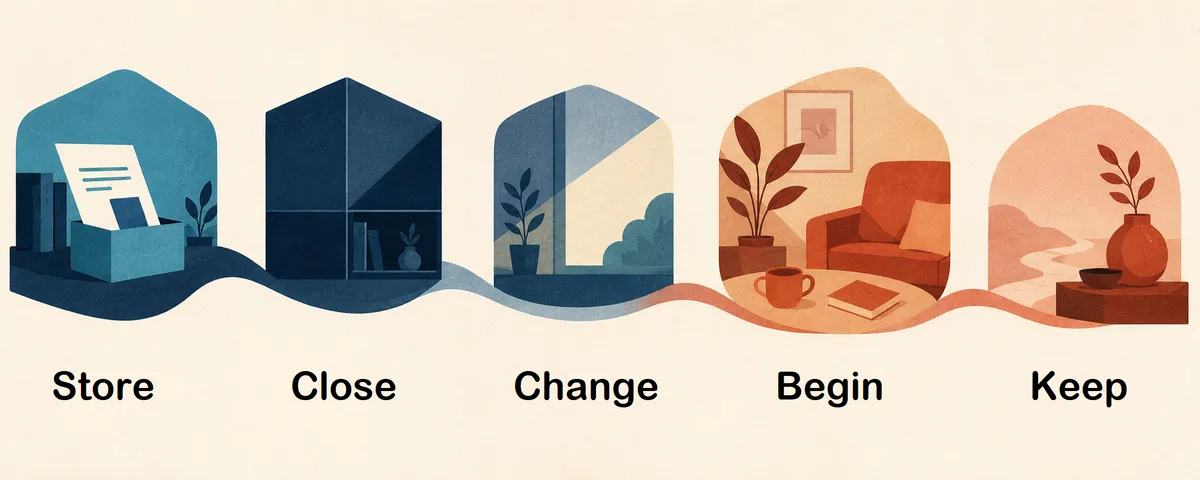
Minute 1: give the unfinished work a tomorrow
Work follows you into the evening when it does not trust you to remember it. The unfinished task keeps repeating itself because no next step has been stored. Your mind rehearses the problem in case tomorrow’s mind loses it. Tomorrow’s mind probably will. So leave it a note. Write three lines:
Stopped at: Next action: Can wait until:
For example:
Stopped at: Pricing section, second draft. Next action: Confirm whether annual billing includes support. Can wait until: 09:30 tomorrow.
That is enough. You are not reviewing the whole day. You are not reorganising the project. You are not turning the final five minutes of work into another forty-five minutes of work about work. You are leaving a return point.
An unfinished task becomes louder when it has no appointed future.
Give it one. If something is genuinely urgent, deal with it honestly. Send the message. Schedule the action. Tell the person when they will hear from you. A transition ritual should not be used to pretend that a deadline does not exist. But most open work is not urgent. It is merely unfinished. Those are not the same thing. When several tasks remain open, store the one most likely to follow you around the house. The complete project review belongs somewhere else.
Tonight does not need the entire map. Tomorrow needs the first turn.
Minute 2: make the workspace inactive
Closing the laptop is useful. It is not always visible enough. The same desk remains. The papers remain. The work phone lights up. The browser may be closed, but the physical room still looks ready for business. Give the ending a shape.
- Close the work tabs.
- Put the laptop to sleep.
- Move papers into one place.
- Change your work status.
- Silence notifications when your role allows it.
- Turn off the desk lamp or monitor.
- Put the work phone in its evening place.
You do not need a separate office. A closed laptop beneath a cloth can be enough. A tray for papers can be enough. Clearing half the kitchen table can be enough. Moving the computer from the centre to the edge can be enough. The boundary does not have to be impressive. It has to be noticeable.
A room can remain the same room and stop being the same place.
When work tries to reopen itself, use a factual sentence:
The next action is stored. I am not deciding it again tonight.
This is not positive thinking. The problem still exists. You have simply stopped holding the meeting before the meeting happens. Some jobs require evening availability. Some people are on call. Some teams operate across time zones. Some responsibilities do not end neatly at 18:00. Make the boundary honest.
I will check urgent messages once at 20:00.
That is a boundary. Holding the phone all evening in case something happens is not availability. It is unfinished waiting. A proportionate boundary is more useful than pretending every worker has the same freedom to disconnect.
Minute 3: change one thing your body can notice
Work is not stored only in thoughts. It is stored in the light, the chair, the posture, the sound of notifications, the clothes you have been wearing since the first meeting. Change one cue. Not five. One.
- Open a window.
- Wash your hands or face.
- Change clothes.
- Walk to the end of the street.
- Move to another chair.
- Make a drink without carrying the phone.
- Change the lighting.
- Play a quiet soundscape.
- Step outside for one minute.
The cue does not have to be soothing. Its job is not to make you serene. Its job is to mark the crossing.
A transition cue does not need to change how you feel. It needs to tell you that something has changed.
That matters because wellness advice often turns every ordinary action into a physiological promise. A glass of water becomes a reset. A breath regulates the nervous system. A song rewires the state. A candle apparently informs the entire body that capitalism has finished for the day. The claims become larger than the action. The action was already useful. You changed the light. You washed the day from your hands. You moved from one chair to another. It does not need a grander biography.
When a cue becomes irritating, replace it. A ritual is useful because it serves the transition. The transition does not exist to serve the ritual.
Minute 4: give home something to begin with
“Stop working” is not an activity. Neither is “relax.” You can spend an entire evening trying to begin something that has no first movement. Choose one ordinary action that belongs to the next part of the day:
- Put ingredients on the counter.
- Take the dog outside.
- Sit with a drink for five minutes.
- Shower.
- Call someone.
- Collect the children.
- Prepare medication.
- Read one page.
- Lie on the floor.
- Do nothing until the minute ends.
Then say:
Now I will [small home action].
The action does not need to improve you. It does not need to be meaningful enough for a Sunday newspaper profile. It does not need to become a habit, streak, or morning-routine video played in reverse. It gives the transition somewhere to land.
You cannot enter “home mode.” You can only begin doing something that belongs to home.
For some people, that is rest. For others, it is a second shift. Dinner needs making. A child needs collecting. A parent needs calling. The dog does not care that your last meeting ran over. A transition ritual that assumes every evening begins with leisure is not designed for real evenings. The first home action can be a responsibility. What matters is that it is now the responsibility in front of you, not something performed while half-reading a message from work.
Minute 5: keep one thing, or keep nothing
At the end of the five minutes, choose one of three endings. You can keep a return point:
Tomorrow, begin with the annual billing question.
You can keep a personal observation:
The day still feels busy. I want ten quiet minutes before conversation.
Or you can keep nothing. Close the note. Move on. Reflection is not the fee you pay to leave work. You do not have to convert every feeling into an insight. You do not have to find gratitude in the final call. You do not have to prove that the ritual changed your mood. “No change” is information. “Nothing to keep” is complete.
A boundary can work before your feelings agree with it.
The workday may still feel present. You may still think about the problem while cooking. You may open the laptop again later. You may not feel particularly restored. The transition still counts. It made one thing explicit that remote work often leaves vague: The next part of the day has begun.
When your desk is in the living room
Remote-work advice likes doors. Close the office door. Leave the room. Keep work out of the living space. This is excellent advice for people who have an office door. For everyone else, the desk may be the dining table. The monitor may face the sofa. The laptop may live beside the place where the evening is supposed to happen. You do not need to erase every sign of work. You need to make the workspace inactive.
- Store the return point.
- Close the laptop.
- Put papers into one container.
- Move the computer out of the central sightline where possible.
- Change the room’s light or sound.
- Sit somewhere else for the first home action.
The room can hold evidence that you have a job. It does not have to remain on duty.
When care work begins immediately
Some people finish work and begin decompressing. Other people finish work because someone is calling their name from the next room. There is no quiet walk. No tea made slowly. No ten minutes in which the household respectfully waits for a personal transition. Use sixty seconds.
- Write the next work action.
- Close the device.
- Wash your hands or take one deliberate breath.
- Name the next responsibility.
That is the ritual. A transition is not more legitimate because it looks calm.
The smallest boundary is still a boundary when it separates two real demands.
You may not get rest. You can still get an ending.
When work finishes at different times
A fixed ritual at 18:00 works well until work ends at 16:30 on Tuesday, 20:00 on Wednesday, and after the final client reply on Thursday. Anchor the transition to an event instead:
- after the final call;
- after sending the handover;
- after closing the work profile;
- after recording tomorrow’s first action;
- before entering the shared living space.
Variable schedules do not always need a fixed time. They need a repeatable ending. The sequence can remain the same even when the clock does not.
When you live alone
Other people create transitions without trying. A partner comes home. A child needs dinner. Someone asks how the day went. The context changes because another person enters it. When you live alone, work can remain the default setting because nothing interrupts it. Use a stronger cue:
- move the laptop;
- leave the home for a short walk;
- change the lighting;
- start a clearly different sound;
- make food;
- shower;
- call someone;
- begin an activity in another part of the room.
The purpose is not to fill every evening. An empty evening is allowed. The purpose is to stop work from occupying the space simply because nothing else claimed it.
Build a menu, not a perfect routine
The perfect routine works on the day it was designed. A menu works on Tuesday. Choose one item from each column:
| Store work | Change the cue | Begin home |
|---|---|---|
| Write the next action | Change the light | Prepare food |
| Schedule the follow-up | Wash your hands or face | Sit quietly |
| Put papers away | Play a Relax soundscape | Call someone |
| Close the work profile | Walk briefly | Begin a care responsibility |
| Send a handover | Change clothes | Read, listen, or do nothing |
One evening you may take a walk. The next evening it may be raining, you may be exhausted, and someone may need dinner immediately. The ritual did not fail. Choose another route.
A routine becomes fragile when only one version of the day is allowed to complete it.
The goal is not consistency of appearance. It is consistency of function: Store the work. Mark the change. Begin what comes next.
Sometimes the missing ritual is not the problem
A five-minute boundary can help when the workday has no visible ending. It cannot make an unreasonable job reasonable. Switching off may remain difficult because:
- the workload routinely exceeds the available hours;
- colleagues expect immediate evening replies;
- responsibilities are unclear;
- the next day contains a decision you are dreading;
- personal and work devices cannot be separated;
- your home offers no controllable boundary;
- persistent stress or low mood is affecting daily life.
Do not turn a structural problem into a failed personal ritual. If the work repeatedly occupies the entire evening, the answer may be a workload conversation, clearer availability rules, changes to the physical environment, rest, or professional support.
No five-minute routine can create a boundary that your workplace is paid to keep crossing.
The ritual can show you where work ends. It cannot force someone else to respect the line.
A transition card
Keep this near the place where work ends:
1. Store: What is the next work action? 2. Close: What makes the workspace inactive? 3. Change: Which cue marks the shift today? 4. Begin: What is the first home action? 5. Keep: Is there one thought worth saving?
The fifth line is optional. The entire card is optional. Use it every day. Use it on difficult days. Stop using it when it no longer helps. There is no streak. You are not building another system that can become disappointed in you.
Where Vayvio fits
Vayvio is designed for moments that do not always receive a clear ending. The workday becomes dinner. The difficult meeting becomes the next task. The focused session ends, but the thought remains open. Vayvio’s 5-Min Reset creates a small space between those states. You can settle without being required to become calm. Acknowledge what is present without solving it. Let the previous moment loosen its hold. Visualise what comes next. Then engage with one action. A Relax soundscape can mark the change.
A short Guided Session can help when you do not want to lead yourself through it. A private check-in or journal line can hold what is worth keeping. None of them is compulsory. The value is not in using the largest number of features. It is in giving one experience somewhere to end before the next one begins. You can also use the ritual in this article with a scrap note and no app.
But when you want the transition, sound, reflection, and next action to live in one private flow, that is what Vayvio is designed to hold. Explore the Vayvio 5-Min Reset or see Vayvio soundscapes.
The distance home may be five metres
Store the loose end. Close the work surface. Change one thing the body can notice. Begin one ordinary part of the evening. Keep one thought, or do not. You may still be in the same room. The desk may still be visible. Tomorrow’s problem may remain unsolved. You may not feel relaxed enough to appear in an advertisement for remote work. That was never the test. The commute used to carry you across the boundary without asking. Now the distance may be five metres.
The distance is smaller. The crossing still matters.