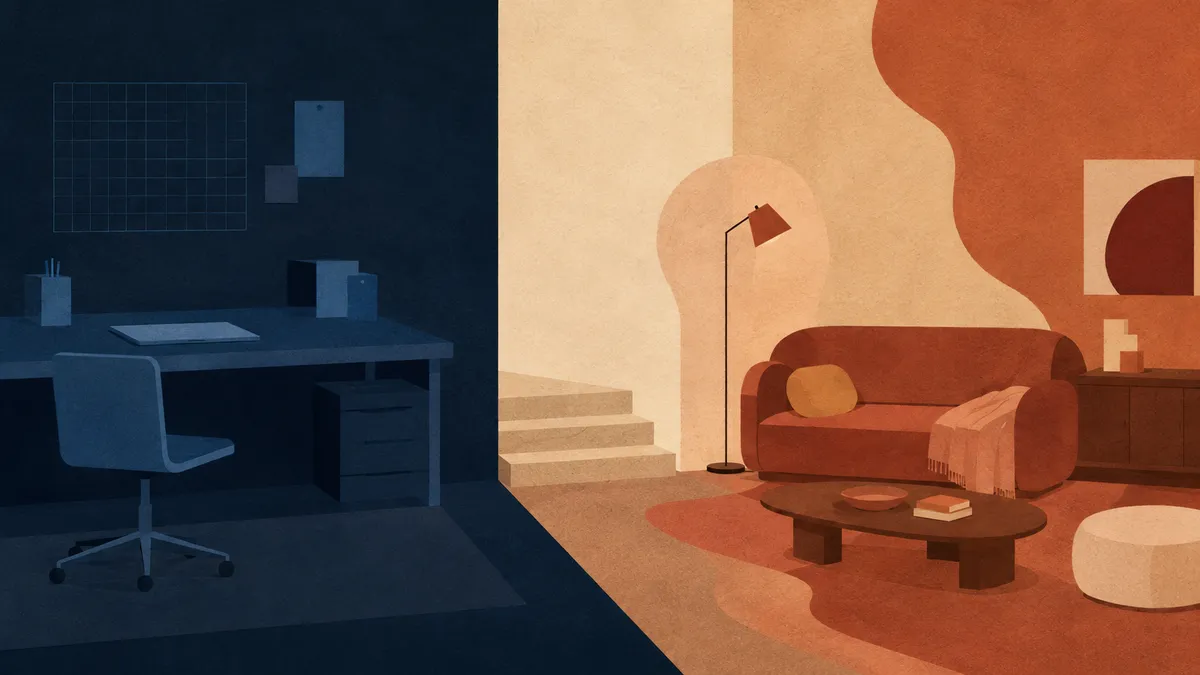
The interruption ended. Your work did not return with you
How to reset after an interruption without rebuilding the whole day.
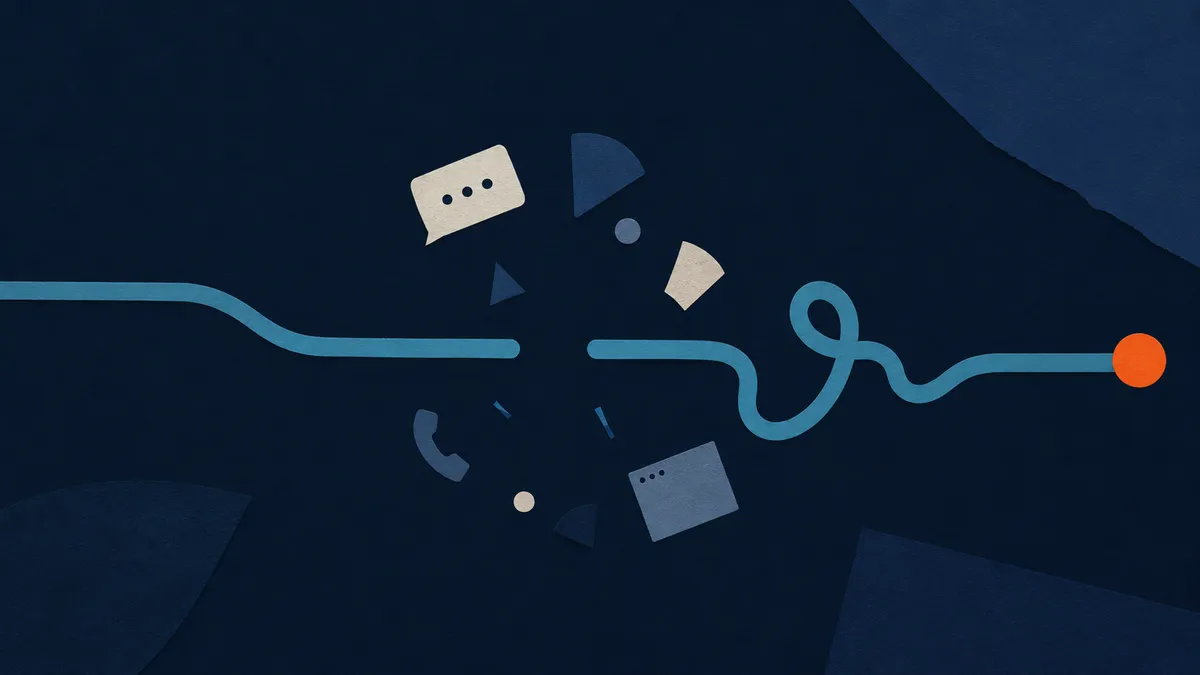
The useful part
Key takeaways
- Stop the interruption from continuing.
- Recover the last known context and choose one visible restart.
- Store a return point before switching away again.
How to reset after an interruption without rebuilding the whole day.
An interruption has two endings. The first is when the call finishes, the person leaves, or you close the message. The second is when your mind returns to the work. Those endings are rarely the same. You sit down again. The document is still open. The cursor is still blinking. Nothing has moved, but the work no longer feels like the work you left. You remember the paragraph. You do not remember what it was trying to do.
You remember the spreadsheet. You do not remember which number looked wrong. You remember that the task mattered. You do not remember why this particular part mattered next. So you wait to feel focused again. That is usually where the interruption gets its second victory.
After an interruption, the problem is often not motivation. It is missing context.
You do not need to recover the mood you had before the interruption. You need to recover the thread. That can take five minutes. The routine is simple:
Stop → Recover → Choose → Bound → Begin
Not because every mind resets in exactly five minutes. It does not. The familiar claim that every interruption costs a fixed number of minutes is too neat. The effect depends on the task, the interruption, and the person. Research on notification interruptions,1 interruptions in office work,2 and cognitive task switching3 supports the more modest point: interruptions and task switching can disrupt performance and make returning harder. Five minutes is not a scientific recovery time. It is a boundary.
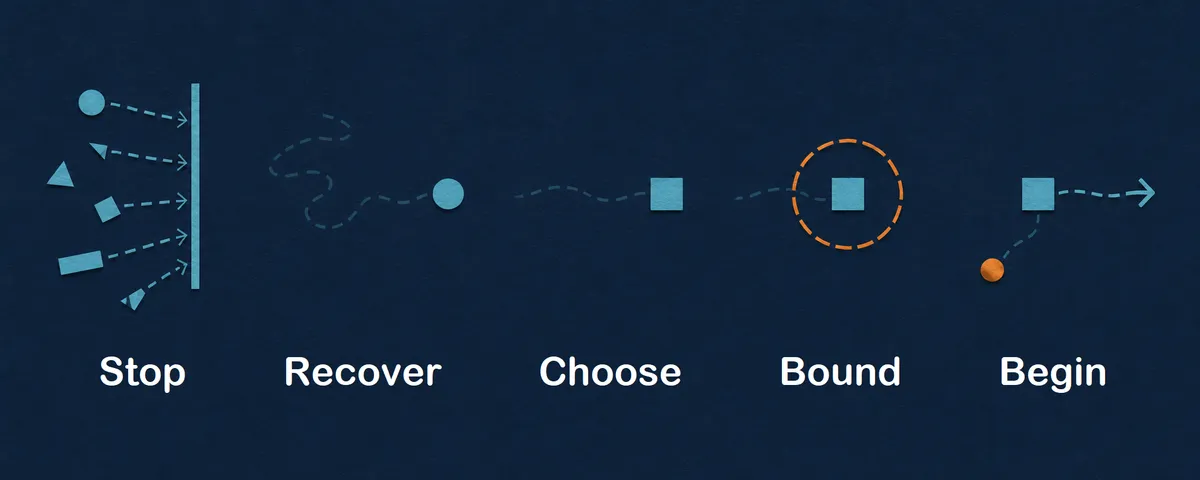
Long enough to find the work again. Short enough that the reset does not become another place to hide from it.
Minute 1: stop the interruption from continuing
The interruption may be over. Its channel may still be open. The meeting has finished, but the notes are on screen. You answered the message, but the thread is still moving. You closed one unrelated tab and found three more waiting behind it. New input keeps the old interruption alive. Close it.
- Leave the message thread.
- Close the meeting notes.
- Put the phone outside reach.
- Silence notifications for the next block.
- Remove the unrelated tabs from view.
This is not a new philosophy of digital minimalism. You do not need to redesign your relationship with technology before lunch. You need ten minutes in which the interruption stops producing sequels.
An interruption is not finished while it still has a door open.
When the interruption was a person, the boundary can be a sentence:
I need ten minutes to get back into this. I will come to you after that.
Not everyone can control the environment. Some jobs are built around responsiveness. Some homes do not provide a closed door. Some days refuse to become quiet. When the environment cannot become smaller, make the restart smaller. Do not demand perfect conditions from a place that cannot provide them.
Minute 2: recover the last thing that was true
Do not begin by rereading everything. That feels responsible. It is often panic with good posture. Look for the nearest reliable marker:
- the final sentence you wrote;
- the comment you were answering;
- the row you had not finished;
- the test that was failing;
- the source you had not assessed;
- the note you left before the meeting.
Then ask:
What was true immediately before I was interrupted?
Write one sentence:
I was [doing something] because [reason or intended outcome].
For example:
I was comparing the two onboarding versions because I need to recommend one for Friday.
The first half restores the action. The second half restores its meaning. “Open the document” is sometimes enough. Often it is not. The document was never the difficult part. The difficult part was remembering what decision the document was supposed to help you make.
Context is not where you were. It is what you were trying to change.
Sometimes the interruption changes the work. A client message creates a real priority. A production issue blocks the release. A call reveals that the old task is no longer useful. Say that clearly:
The previous task is paused. The client correction is now the priority because it blocks today’s release.
That is not losing focus. That is choosing again. There is a difference between changing direction and being dragged in several directions at once.
Minute 3: choose the smallest credible restart
Do not tell yourself to “get back into it.” There is nothing visible to do in that sentence. Choose an action that reconnects you to the task and can begin within a few minutes:
- Read the last two paragraphs and mark the unresolved claim.
- Run the test that was failing before the call.
- Reopen the spreadsheet and identify the incomplete row.
- Write one rough sentence beneath the heading.
- Add three saved sources to the draft before evaluating them.
- Read the comment you were answering and write the first line of the reply.
Use this prompt:
The next visible move is [action].
“Finish the report” is not a visible move. Neither is “focus properly.” Those are outcomes. Outcomes are terrible doors. A credible restart is smaller. You can point to where it happens. You can watch yourself begin it. You could stop after doing it and still know the task has moved.
The first action after an interruption should not prove your discipline. It should restore your position.
When you cannot name the next move, the problem may not be the interruption. The task may be unclear. A decision may be missing. Someone may need to answer a question before useful work can continue. In that case, do not simulate progress. Write the question. Ask for the information. Make a reversible choice when appropriate. Clarity is sometimes the work.
Minute 4: put a boundary around the return
Choose a short block.
- 10 minutes when the restart feels fragile.
- 15 minutes when the thread is beginning to return.
- 25 minutes when the task is clear and the next interruption is unlikely.
The timer does not promise that you will be focused for the whole block. It promises that you will reconsider later. That is enough. A returning mind often does not trust the task yet. It has just been asked to leave once. It expects to be asked again. A short boundary makes a smaller demand. Not: finish the report. Not: recover the lost afternoon. Just: stay with this visible action until the timer ends.
You can use silence. You can also use a familiar background sound that marks the return without asking for attention. A steady ambient texture. A soft nature recording. An instrumental loop you already know. The sound does not need to activate focus.
A useful background does not pull you into the work. It stops pulling you away from it.
If it becomes noticeable, lower it. Change it. Turn it off. The ritual is not the point. The switch is. Practical guidance on returning after an interruption often recommends making the transition explicit: close the interruption source, move briefly, or deliberately re-enter the task.4 The useful part is not performing a perfect reset. It is recognising that one state has ended and another needs to begin.
Minute 5: begin before the reset becomes another delay
This is the minute people lose. The tabs are closed. The note is written. The timer is ready. The sound is playing. Everything is prepared except the work. Begin before the five minutes end. Read the paragraph. Run the test. Write the bad first sentence. Check the incomplete row. Do not spend the whole reset constructing ideal conditions for a task that only needed one action. For the first block:
- keep the interruption channel closed;
- stay with the named action;
- do not reorganise the entire project;
- do not repeatedly check whether you feel focused;
- return when you notice your attention has moved.
You may not feel the moment when focus comes back. Most of the time, there is no moment. There is only a sentence, then another one, and eventually the work feels like yours again.
You do not return to work by feeling ready. You feel returned after you have begun.
Leave something behind before the next interruption
Some interruptions cannot wait. A child needs you. A colleague needs an answer. A problem becomes urgent. You have thirty seconds before the next call. Leave a note:
Stopped at [place]. Next is [action]. The open question is [question].
Fifteen seconds can save ten minutes later. People assume memory will preserve the important part because the task feels obvious now. It will not. The person returning tomorrow will know less than the person leaving today.
A return point is a message sent from the mind that still remembers to the mind that soon will not.
Leave the message.
After a meeting
Meetings create a particular kind of interruption. They replace one context with another, add several possible tasks, and then release you back into the day as though nothing happened. Do five things:
- Write down the meeting’s one required follow-up.
- Put it somewhere you trust.
- Close the meeting documents.
- Read the return point for the previous task.
- Begin with a ten-minute block.
Do not act on every meeting idea immediately. Ideas can feel urgent because they are fresh. Freshness is not priority. A meeting should not be allowed to occupy every minute after it has ended.
After a message that creates worry
Some messages continue long after you have answered them. The practical action may be small. The meaning your mind attaches to it may not be. Write two lines:
Action: Ask finance for the corrected figure at 15:00. Not now: Decide whether the entire launch date needs to move.
This does not remove the concern. It gives the concern edges. Without those edges, the practical problem and every possible consequence become one large thing called worry. That thing is difficult to put down because it has no clear shape.
You do not always need to resolve a worry before working. Sometimes you need to separate what can be done from what can only be imagined.
After an unplanned browsing detour
You look up one detail. Twenty minutes later, you know several things you did not need to know and have forgotten the thing you meant to check. Close the tabs. Do not punish the detour with a heroic catch-up plan. Do not decide that, because twenty minutes were lost, the next twenty must be perfect. Ask what happened. Were you looking for information? Avoiding uncertainty? Waiting for the task to become clearer? Following a habit without noticing? You do not need a full psychological explanation.
You need the next honest move.
- Reopen the last work marker.
- Name one visible restart.
- Choose ten minutes.
- Record the blocker if the task itself is the problem.
“Work twice as hard” restores nothing. Pressure does not reconstruct context.
A reusable interruption card
Copy this into a note:
Return point I was: Because: Next visible move: Open question: Boundary: 10 / 15 / 25 minutes
Use the lines that help. Leave the others blank. The card is not another form you have failed to complete. It is a place to put information your mind should not have to carry through every interruption.
Sometimes the right answer is not to resume
A reset should restore choice. It should not automatically send you back to the previous task.
| Situation | Decision |
|---|---|
| The interruption was brief and the task still matters | Resume from the return point. |
| The interruption created a genuinely higher priority | Replace the task deliberately and store the old return point. |
| There is too little time for a credible block | Save the context and schedule the return. |
| The task is blocked by missing information | Ask for it instead of simulating progress. |
| You are depleted or the work would be unsafe or inaccurate | Reduce the task or stop. |
Not every failure to resume is a focus problem. Sometimes the day changed. Sometimes the workload is unrealistic. Sometimes the environment keeps interrupting because constant responsiveness is part of the role. Sometimes you are tired enough that continuing would produce worse work and a worse evening. A five-minute routine cannot repair all of that. It cannot replace sleep, workload negotiation, environmental change, or professional support when persistent distress or concentration difficulties are affecting daily life.
A wellness technique should not turn every human limit into a personal failure.
Where Vayvio fits
Vayvio’s 5-Min Reset is designed for the space between one state and the next. It moves through five phases:
Settle → Acknowledge → Let go → Visualise → Engage
Not to guarantee calm. Not to erase the interruption. Not to insist that five minutes is enough for every person or situation. The reset creates a boundary. It notices what is present. It gives the previous moment somewhere to end. Then it finishes with one next action. A better mood is not required. A journal entry is not required. “No change” is a valid response. So is “skip.”
You can use the manual routine in this article without Vayvio. A scrap note and a timer are enough. But when you want the transition, sound, timer, check-in, and next action to live in one private flow, that is what Vayvio is designed to hold. Explore the Vayvio 5-Min Reset or see how Vayvio works.
Do not rebuild the whole day
The interruption happened. The work moved further away than the open document suggests. That does not mean the day is lost. Close the door the interruption used. Recover the last thing that was true. Choose one visible move. Give it ten minutes. Then begin before the reset becomes another task. You do not need to recreate the person you were before the interruption.
You only need to leave the person you are now a clear way back in.
Sources and further reading
- Ohly, S., and Bastin, L. (2023).Effects of task interruptions caused by notifications from communication applications on strain and performance.Journal of Occupational HealthFull text
- Rick, V. B., Brandl, C., Mertens, A., and Nitsch, V. (2024).Work interruptions of office workers: The influence of the complexity of primary work tasks on the perception of interruptions.WorkFull text
- Egner, T. (2023).Principles of cognitive control over task focus and task switching.Nature Reviews PsychologyFull text
- Editorial guidance on deliberate task re-entry.3 Ways to Bounce Back After a Work Interruption.Duke Today